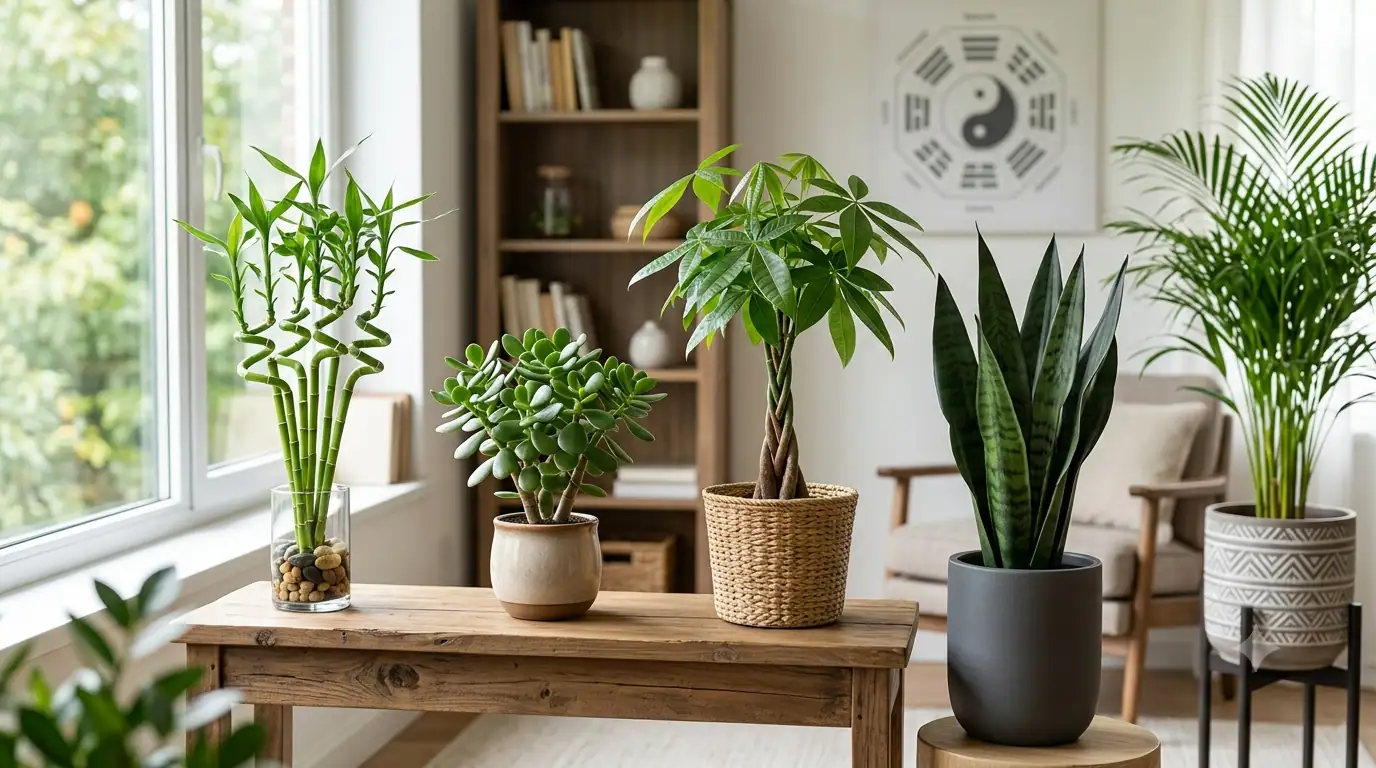
The best feng shui plants for the home are the jade plant, money tree, lucky bamboo, snake plant, peace lily, and areca palm. Each is linked to a traditional meaning, such as wealth, protection, or calm, and each has a spot in the home where it is usually placed. Below, you will find what each indoor plant stands for, where to put it, and the light and water it needs to stay healthy, because a struggling plant is generally seen as working against the purpose of keeping it.
Understanding the Role of Plants in Feng Shui Practice
In traditional feng shui, everything in a living space corresponds to one of five elements: Wood, Fire, Earth, Metal, and Water. Living houseplants represent the Wood element, which stands for growth and vitality. Placed with care, they are believed to help energy (chi) move smoothly, soften sharp corners, and make a room feel more welcoming. Feng shui is a traditional practice, and these effects are beliefs rather than proven results. What you can be sure of is that plants need the right light and water, which is why each plant below includes care basics.
However, a dying, neglected plant produces the exact opposite effect, generating draining energy (si chi). For this reason, selecting the right plant for your specific room conditions is the most critical step. The best feng shui plant for your home is always a healthy one.
1. Jade Plant (Crassula ovata)
Commonly known as the “Money Plant,” the Jade Plant is one of the most famous feng shui plants used to invite financial prosperity, abundance, and success. Because it features plump, coin-shaped succulent leaves that naturally retain water, it structurally symbolizes wealth storage and continuous growth.
- Traditional Feng Shui Placement: Place your Jade Plant near the main entryway of your home to welcome incoming wealth, or set it directly in your home’s Southeast sector (the wealth and abundance corner).
- Horticultural Care Reality: As a succulent, Jade thrives on minimal intervention. Give it bright, indirect sunlight or a few hours of direct morning sun. Never overwater it; allow the soil to dry out completely down to the bottom of the pot before giving it a thorough soak.
2. Money Tree (Pachira aquatica)
The Money Tree is another iconic plant explicitly tied to good fortune and business luck. Its famous braided trunk is said to lock in and trap prosperous energy within its folds, while its five-lobed green leaf clusters are traditionally thought to represent the five balanced elements of feng shui working together in harmony.
- Traditional Feng Shui Placement: This plant is an excellent choice for home offices, creative studios, and living rooms where financial decisions, work, or family gatherings take place.
- Horticultural Care Reality: The Money Tree prefers moderate to bright indirect light and loves higher humidity. To avoid root rot, wait until the top two inches of soil feel completely dry before watering again, and ensure the pot has functional drainage holes.
3. Lucky Bamboo (Dracaena sanderiana)
Despite its common name, Lucky Bamboo is actually a member of the Dracaena family, not a true botanical bamboo. In feng shui tradition, the number of stalks in your arrangement determines its energetic focus: three stalks symbolize happiness and long life, five stalks represent wealth, and six stalks invite good luck.
- Traditional Feng Shui Placement: Position Lucky Bamboo in the East sector of your home to support family health, or place it on your desk to stimulate professional advancement.
- Horticultural Care Reality: This is one of the lowest-maintenance houseplants available. It can grow directly in a vase filled with water and clean pebbles instead of soil. Simply change the water weekly to prevent algae buildup, keep it in soft, indirect lighting, and avoid harsh direct sun which bleaches the stalks.
4. Snake Plant (Sansevieria / Dracaena)
Snake plants are celebrated in feng shui for their protective, shielding energy. Their sharp, sword-like leaves shoot directly upward, acting as architectural shields that slice through negative or aggressive energy.
- Traditional Feng Shui Placement: Because of its protective nature, it is traditionally placed near front entryways, large windows, or home offices. If you like darker foliage, the Black Coral snake plant is a deep-green cultivar, and you can read how to care for a Black Coral snake plant indoors before choosing one.
- Horticultural Care Reality: Snake plants are incredibly forgiving. They tolerate extended periods of drought and adapt easily to low-light rooms, making them perfect for spaces where other houseplants struggle.
5. Peace Lily (Spathiphyllum)
The Peace Lily is deeply valued for its ability to cultivate deep harmony, emotional balance, and a sense of calm. Its elegant white blooms emerge like flags of truce, making it a wonderful addition to spaces where you go to unwind and recharge.
- Traditional Feng Shui Placement: Peace lilies are ideal for quiet areas like bedrooms, meditation corners, or living rooms.
- The Pet Warning: If you share your home with animals, safety must come first. Before bringing one into your space, check out our guide on whether peace lilies are toxic to cats to understand how to handle this plant safely around curious pets.
- Horticultural Care Reality: Peace lilies prefer medium to low indirect light and will tell you exactly when they need a drink by visibly drooping their leaves. Water them thoroughly as soon as they start to flag, and they will perk up within a few hours.
6. Areca Palm (Chrysalidocarpus lutescens)
With its soft, arching fronds, the Areca Palm brings a gentle, flowing look to a room. In feng shui, it is used to soften empty corners where energy is thought to stall.
- Traditional Feng Shui Placement: Place large Areca Palms in empty corners of the living room or dining room to keep energy circulating smoothly throughout the home.
- Horticultural Care Reality: Areca Palms require a bit more attention than succulents. They demand bright, indirect sunlight and consistently moist (but never soggy) soil. If the air in your home gets too dry, the tips of the fronds will turn brown, so they benefit from being grouped with other moisture-loving plants.
Mapping Your Space: Where Placement Traditionally Matters
While different schools of feng shui utilize different maps (such as the Bagua map), a few foundational guidelines regarding plant placement remain consistent across traditional practices:
- The Southeast (the wealth sector): In the compass-based method, this area is linked to money and prosperity, which is why jade plants and money trees are often placed here. Some schools use the Bagua map from your front door instead, where the wealth area is the far left corner as you enter.
- The East (The Health Sector): This sector is tied to family harmony and new beginnings. Soft, lush, green leafy plants thrive energetically here.
- The Sharp Foliage Rule: Historically, traditional feng shui advice recommends avoiding heavily thorny plants (like cacti) directly inside central living areas or bedrooms, as their sharp needles can radiate spiky energy (sha chi). However, many modern practitioners use them intentionally on exterior windowsills or near doors to deflect negative energy coming from the outside world.
| Home Area | Recommended Plant |
|---|---|
| Southeast (Wealth) | Jade Plant, Money Tree |
| East (Health & Family) | Lucky Bamboo, Areca Palm |
| Entryway | Jade Plant, Snake Plant |
| Living Room | Peace Lily, Money Tree |
| Home Office | Snake Plant, Money Tree |
| Bedroom | Peace Lily |
Some feng shui teachers prefer to keep bedrooms free of plants or limit them to one small plant, because the room is meant for rest. If you keep one, a single peace lily is the usual choice.
Best Feng Shui Plants for the Living Room
The living room is where people gather, so feng shui advice usually favors plants that feel open and welcoming. Money tree and peace lily are the two plants this guide pairs with the living room, and an areca palm works well in an empty corner if you have floor space. Money tree and areca palm both need bright, indirect light, so keep them near a window. A peace lily tolerates lower light, which makes it easier to place deeper in the room. If the room gets very little daylight, a snake plant is the most forgiving option. Keep plants out of walkways so people can move through the room easily.
Creative Styling Ideas for a Balanced Display
Arranging your feng shui plants in balanced, visually pleasing compositions is an excellent way to amplify the peaceful energy of a room.
If you love a layered, multi-dimensional plant shelf, consider mixing textures. For instance, pairing the rigid, upright vertical lines of a snake plant with the soft, cascading leaves of a Lemon Lime prayer plant creates a beautiful visual and energetic contrast of yin and yang forms.
Avoid overcrowding multiple large plants in one corner. Leave enough space for air circulation and natural light to reach each plant. Mixing upright plants with trailing or broad-leaved varieties creates a balanced and visually pleasing display.
To expand your display styles beyond standard ceramic pots, look into alternative mounting options. If you are entirely new to indoor gardening and want to make sure your new layout stays vibrant, take a quick look through our beginner indoor plant guide to build a solid foundation.
Quick FAQ
Do feng shui plants require special care compared to normal houseplants?
No. A plant’s feng shui status is entirely derived from its cultural symbolism, leaf shape, and directional placement within a room. It does not alter the plant’s underlying biology. A Jade plant still requires succulent care, and a palm still requires tropical care, regardless of where it sits on a Bagua map.
Can I use artificial or faux plants for feng shui?
Live plants are always preferred because they emit active, growing, and changing organic energy. However, if you have a windowless room or a dark hallway where a real plant would inevitably die, a high-quality, clean, realistic artificial plant is far better than keeping a real plant that is actively dying.
What should I do if a feng shui plant dies?
Do not panic. Plants absorbing negative energy or running through their natural lifecycles is a normal part of indoor gardening. Simply thank the plant for its service, remove it from your home immediately so it doesn’t create stagnant energy, and replace it with a fresh, healthy specimen when you are ready.
Which feng shui plant is considered best for attracting wealth?
The Jade Plant and Money Tree are the two plants most commonly associated with prosperity and financial abundance in traditional feng shui.
Where should I place a feng shui plant in my home?
Placement depends on the plant’s traditional symbolism, but the southeast corner, entryway, living room, and home office are among the most popular locations.
Can I keep more than one feng shui plant in the same room?
Yes. Combining healthy plants with different shapes and sizes can create a balanced display, provided each plant has enough light and space to grow.
Do feng shui plants need direct sunlight?
It depends on the species. Always provide the lighting conditions that suit the individual plant rather than placing it somewhere unsuitable for symbolic reasons.
Which feng shui plant is easiest for beginners?
Snake Plant and Lucky Bamboo are excellent beginner-friendly choices because they are adaptable and require relatively little maintenance.
What are the best feng shui plants for the living room?
Money tree and peace lily are the usual living room choices, and an areca palm suits an empty corner. Choose based on light: money tree and areca palm need bright, indirect light, while a peace lily copes with less. Keep plants out of walkways so the room stays easy to move through.
Are feng shui plants safe for cats and dogs?
Not all of them. According to the ASPCA, money tree and areca palm are listed as non-toxic to cats and dogs, while jade plant, snake plant, peace lily, and lucky bamboo are listed as toxic. If you have pets, choose the safer plants or place the others out of reach.