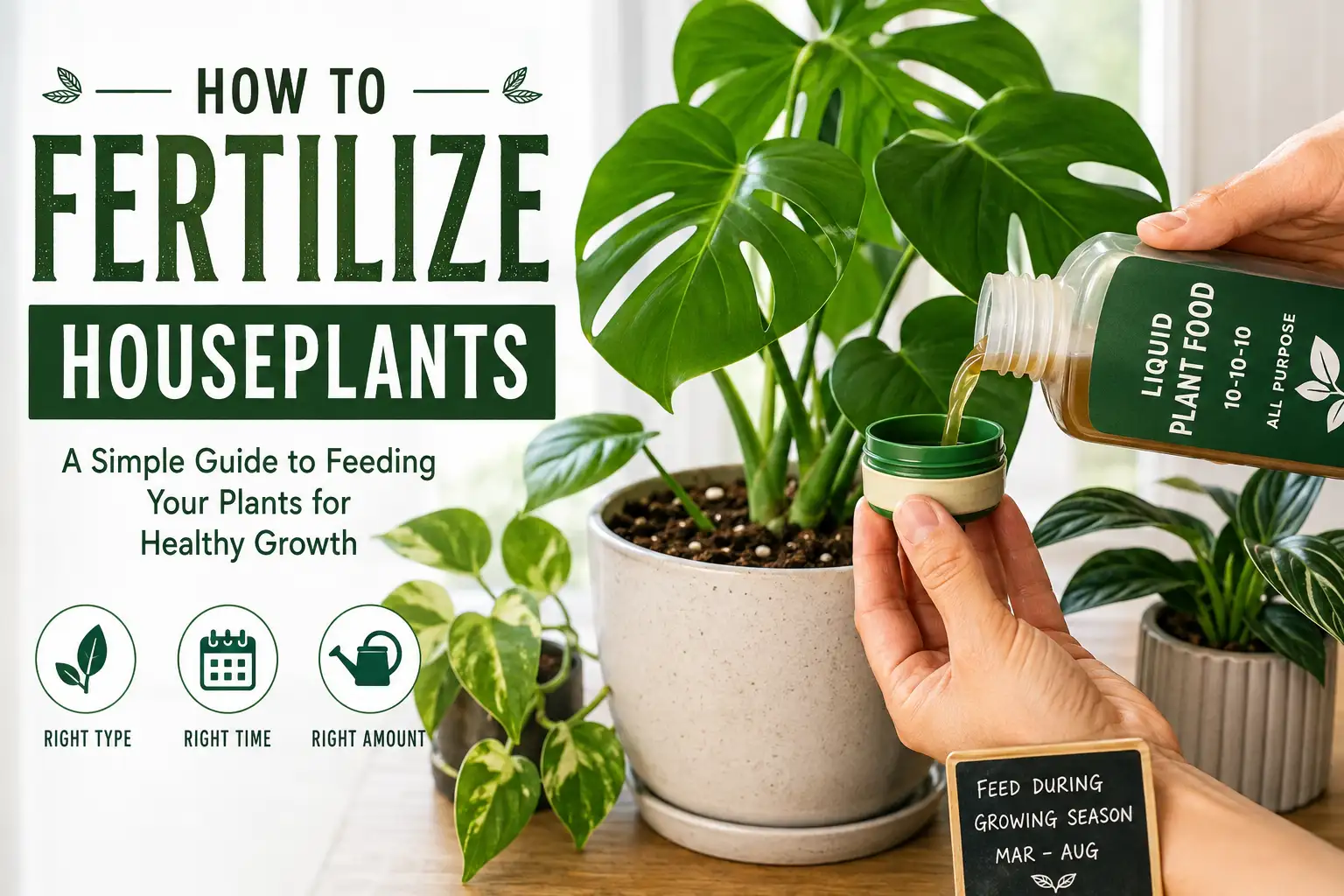
I over-fertilised a monstera once and spent three months wondering why the new leaves kept coming out small and distorted. The soil smelled slightly chemical after watering and a white crust had built up around the rim of the pot. I had been feeding it every two weeks at full strength because I thought more nutrients meant faster, healthier growth. It does not work that way. Over-fertilising causes salt buildup in the soil that damages roots and actually prevents the plant from absorbing water and nutrients properly, which is the opposite of what you are trying to achieve. That experience is what finally pushed me to actually understand how to fertilize houseplants rather than just follow the label without thinking.
Most houseplants grown in a standard potting mix will eventually need supplemental feeding, since the nutrients in bagged soil are typically exhausted within three to six months. After that, the plant is relying entirely on what is in its immediate root environment, which in a pot is a fairly limited space. Getting the type, frequency, and timing of fertilising right is genuinely simple once you understand a few basic principles.
What is NPK Fertilizer? Understanding the Numbers on Fertilizer Labels
Every fertiliser label shows three numbers, such as 10-10-10 or 5-10-5. These represent the percentages of nitrogen (N), phosphorus (P), and potassium (K) in the product. Each nutrient does a specific job.
Nitrogen drives leafy, green growth. A plant that is growing quickly and producing lots of new foliage needs adequate nitrogen. Phosphorus supports root development and flower production. Potassium strengthens the overall plant, improves disease resistance, and helps with water regulation through the cells. For most foliage houseplants, a balanced formula where all three numbers are equal is the right starting point. For flowering plants, a slightly higher phosphorus middle number helps during the flowering period.
What is The Best Fertilizer for Indoor Houseplants?
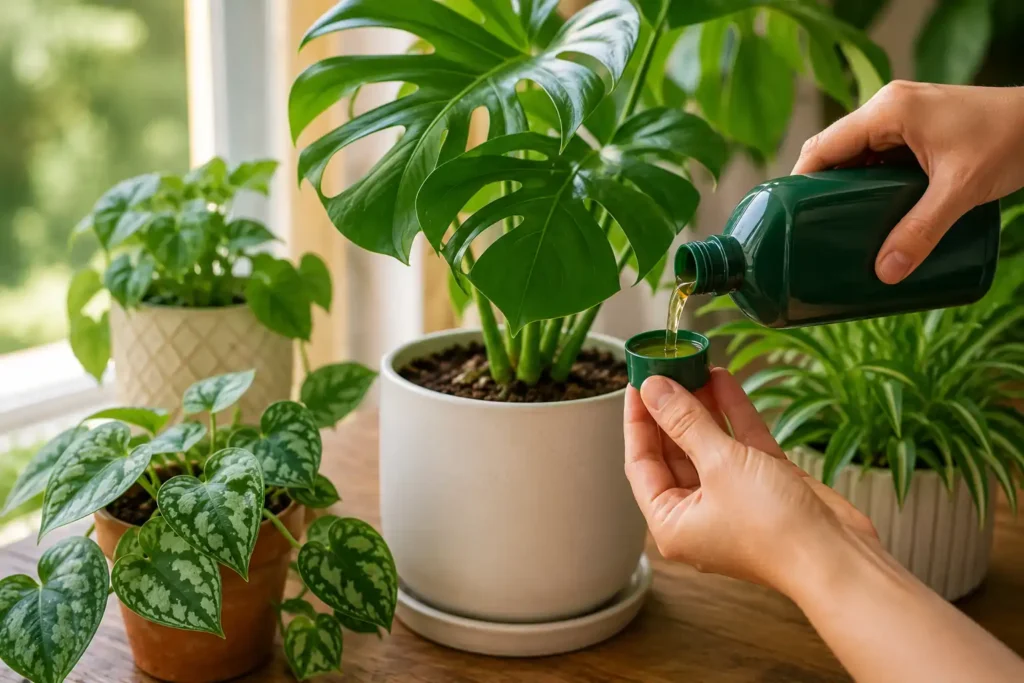
Liquid fertilisers are the most practical choice for most houseplant growers because they are easy to dilute, easy to apply during regular watering, and the nutrients are immediately available to roots. They do require more frequent application, typically every two to four weeks during the growing season.
Slow-release granular fertilisers are worked into the surface of the potting mix and release nutrients gradually over several months. They require less ongoing attention and are a good option if you want to fertilise less frequently. The downside is that you cannot adjust the feeding rate if a problem develops, and in overwatering situations the granules can release nutrients too quickly.
Organic options including worm castings, fish emulsion, and compost tea all work well and are gentler on roots than synthetic fertilisers at equivalent concentrations. They also improve soil biology over time rather than just delivering chemical nutrients. For how organic amendments like biochar work alongside fertilising to improve overall soil health, our post on biochar for houseplants covers the soil improvement side of the equation.
How Often Should You Fertilize Houseplants Throughout the Year?
The growing season runs from roughly March through September for most houseplants in the US. This is when the plant is actively producing new growth and can make use of added nutrients. During this window, apply a balanced liquid fertiliser every two to four weeks, diluted to half the strength shown on the label. Half strength applied more frequently is gentler and more effective than full strength applied less often.
From October through February, most houseplants slow their growth significantly in response to lower light levels and shorter days. Fertilising during this period does more harm than good. The nutrients sit unused in the soil and accumulate as salts, eventually affecting root health. The rule is simple: if the plant is not actively growing, it does not need feeding.
Signs Your Houseplant Needs Fertilizer?
Pale, yellowing older leaves on a plant that is otherwise receiving good light and correct watering is one of the clearest signs of nitrogen deficiency. The plant pulls nitrogen from older leaves to support new growth, so the lower leaves yellow first. A few doses of balanced fertiliser during the growing season usually reverses this within a month.
Slow or stopped growth during the spring and summer growing season, when the plant should be producing new leaves regularly, can also indicate nutrient deficiency. Before adding fertiliser, check that light and watering are correct, since those are more likely causes of slow growth. Fertiliser is not a substitute for the right growing conditions. Our guide on the most common plant care mistakes beginners make covers how to distinguish fertiliser issues from watering and light problems.
Signs of Over-Fertilizing Houseplants
A white or yellowish crust building up on the soil surface or around the rim of the pot is fertiliser salt accumulation, and it is a reliable sign you are feeding too often or at too high a concentration. Brown, crispy leaf tips on a plant that is watered correctly and has adequate humidity is another common symptom of fertiliser salt damage.
If you suspect salt buildup, flush the soil by watering very thoroughly several times in succession, letting it drain completely each time. This washes accumulated salts through the drainage holes and out of the root zone. After flushing, hold off fertilising for at least four to six weeks before restarting at a lower concentration.
How to Fertilize Different Types of Houseplants
Foliage plants like monstera, fiddle leaf fig, and Chinese evergreen do best with a balanced formula applied monthly during the growing season. Our monstera care guide mentions what to look for when the plant is under or over fed, which applies to most large tropical foliage plants.
Flowering plants, including peace lilies and hoyas while in bud, benefit from a fertiliser with a higher phosphorus value to support bloom development. Switch back to balanced feeding after flowering is finished.
Succulents and cacti need far less fertiliser than tropical plants. A single application of a diluted cactus fertiliser in spring is enough for most. For more on succulent care including soil and feeding, our succulent planting guide covers everything specific to that category.
Calatheas and prayer plants are sensitive to fertiliser salts and do better with a weaker solution applied at half the dilution you would use for other plants. Our calathea care guide covers this in the context of their overall sensitivity to water and soil quality.
When to Fertilize Houseplants After Repotting
Fresh potting mix contains slow-release nutrients that last roughly three to six months. After repotting, there is no need to fertilise immediately. Wait until the plant has settled into the new pot for four to six weeks, then begin a normal feeding schedule when the growing season supports it.
Fertilising a freshly repotted plant, particularly one whose roots were disturbed or trimmed, risks burning the tender new root growth before it has had time to recover. Our repotting guide covers this timing in detail as part of the aftercare section.
A Simple Houseplant Fertilizing Schedule That Works Best
The approach I have settled on after years of getting it wrong in both directions is this: half-strength balanced liquid fertiliser every three to four weeks from March through August, nothing at all from September through February, and a quick visual check of the soil surface before every growing-season application to make sure no salt buildup is developing.
That is a total of about six feeding sessions per year per plant. It takes less than five minutes, and the results across my whole collection have been consistently better than when I was feeding more frequently at full strength. Simpler is genuinely better with fertilising.
Frequently Asked Questions About Fertilizing Houseplants
How often should I fertilize my houseplants?
Every two to four weeks during the active growing season, typically March through August, is the right frequency for most liquid fertilisers. Reduce concentration to half strength rather than applying at the full label rate. Stop completely from autumn through winter when most plants are not actively growing.
Can I use outdoor plant fertilizer on my houseplants?
Many outdoor balanced fertilisers work for houseplants, but lawn fertilisers are usually very high in nitrogen and should be avoided. High-nitrogen formulas push leafy growth but can cause salt damage at the concentrations used for outdoor application. A dedicated houseplant fertiliser is a safer choice since it is formulated for the smaller soil volumes of pots.
Why are my plant’s leaf tips turning brown after fertilizing?
Brown leaf tips after fertilising usually mean salt damage from too high a concentration or too frequent application. Flush the soil thoroughly by watering several times in succession and letting it drain completely, then hold off fertilising for a month before restarting at a lower concentration.
Should I fertilize a newly repotted plant?
Wait four to six weeks after repotting before fertilising. Fresh potting mix contains nutrients already, and fertilising immediately after repotting risks burning newly disturbed roots before they have recovered. Begin a normal schedule once the plant has settled and new growth is visible.
Is it better to fertilize in the morning or evening?
Timing within the day does not significantly affect how plants absorb nutrients from soil fertiliser. What matters more is not applying liquid fertiliser to bone-dry soil, since this concentrates the solution around roots before they can absorb it with water. Water the plant lightly before applying fertiliser if the soil is very dry.
Can over-fertilizing kill a houseplant?
Severe, repeated over-fertilising can kill a plant by damaging the root system to the point where it can no longer absorb water. The symptoms, brown leaf tips, wilting despite moist soil, and white salt crusting on the soil, appear gradually. Catching it early and flushing the soil usually allows full recovery. Chronic mild over-fertilising produces stunted, stressed plants rather than sudden death.
Have questions about feeding your houseplants? Drop them in the comments below. I read every one and love talking about this stuff.